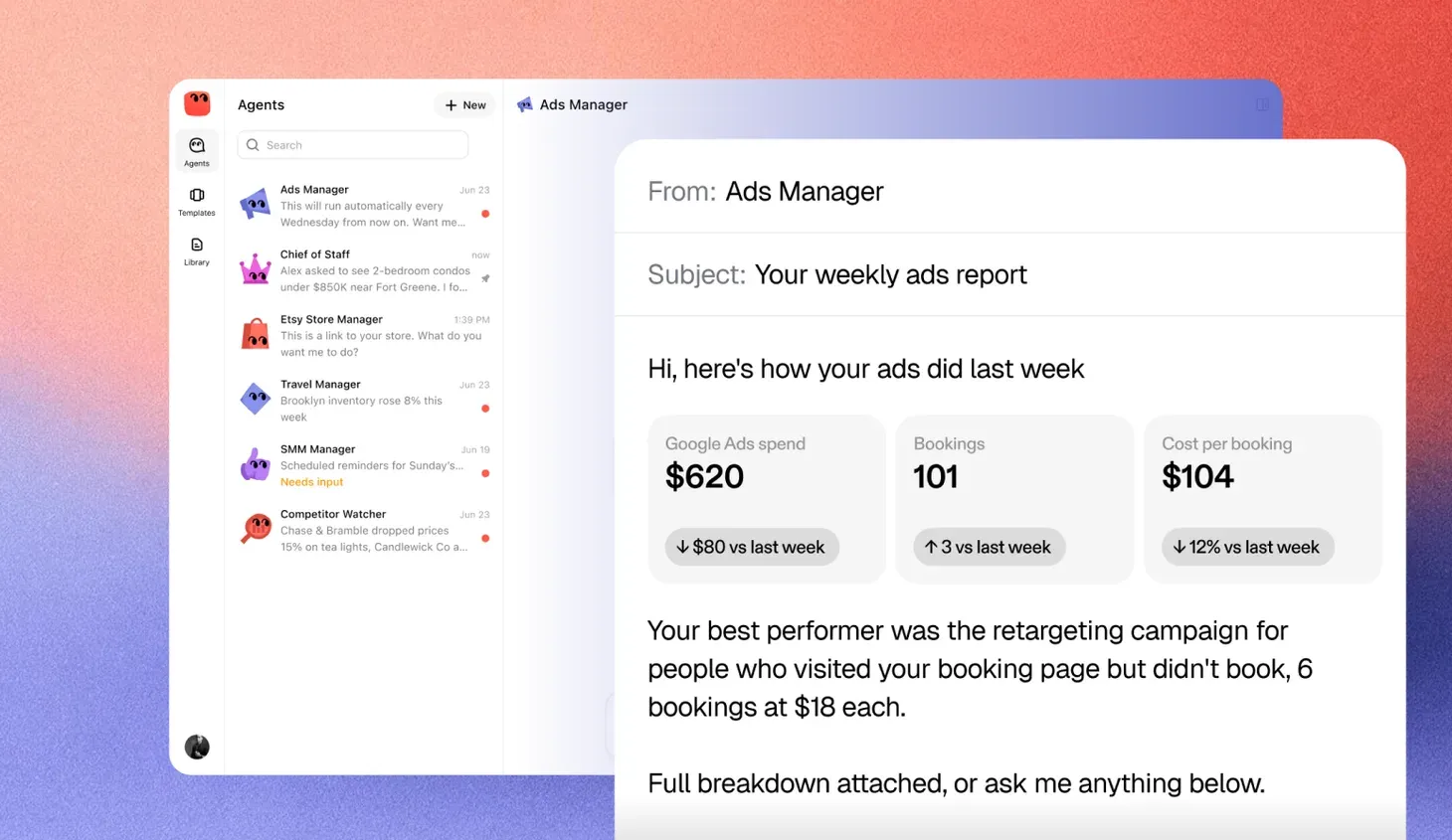
AI that acts, not only answers
Agentic AI is AI that acts toward a goal instead of only answering a question. You give it an outcome, like “keep every lead in the CRM followed up within a day.” It works out the steps, uses your tools to carry them out, checks the result and comes back to you when a decision is yours.
The word “agentic” means having agency, the capacity to act. A chat assistant has very little. It waits for you, answers and stops. Agentic software keeps going on its own, inside limits you set.
Where the term came from
The idea of an agent is as old as AI research. Textbooks have long described an agent as anything that perceives its surroundings and acts on them toward a goal, and psychologists used “agentic” for human agency long before software did. The adjective entered everyday AI talk in March 2024, when Andrew Ng spoke about “agentic workflows” at a Sequoia Capital event. He chose the adjective on purpose. Rather than arguing over whether a system was a true agent, he wanted to describe systems as more or less agentic, and he named four patterns that make them so. Those patterns are reflection, tool use, planning and several agents working together.
Seven months later the term crossed into the boardroom. In October 2024 Gartner named agentic AI the top strategic technology trend for 2025, describing systems that plan and act on their own to meet goals a user sets. It predicted that by 2028 a third of enterprise software would include agentic AI, up from under 1% in 2024.
How each side uses the word
The term now means slightly different things depending on who is speaking.
- Developers use it for a way of building. An agentic workflow calls a model several times, lets it use tools like search or code, checks its own output and loops until the task is done. Frameworks and coding agents are built around that loop.
- Enterprise buyers and analysts use it for a kind of workforce. To them agentic AI means software that takes ownership of a business process, like invoice exceptions or IT tickets, across the systems the company already runs.
- Vendors use it for almost anything with a language model inside, which is where the confusion starts.
That is the plain meaning, and its history. The trouble is that the word is now on nearly every product page, and it often means much less. This article sets out what the term should mean when an enterprise is deciding what to buy and how to run it.
Why the term is slippery
Marketing has stretched “agentic” to cover almost anything with a language model inside. Three common stretches are worth spotting.
- A chat window with a new name. The product answers questions, and calls each answer an agent’s work.
- A fixed workflow with a model in one step. A rule fires, a model writes one paragraph and the rule carries on. Useful, and not agentic.
- A demo that acts once. The product books a meeting in a video, but in practice it needs a person to start every run.
None of these is bad software. The problem is buying one while expecting the other. A business that thinks it has an agent chasing invoices, and in fact has a drafting tool, finds out when the invoices are still unpaid a month later.
What it should mean in practice
A useful definition is one you can test. For software to count as agentic, it should do five things.
- Hold a goal over time. It keeps working on the same outcome across days or weeks without being asked again.
- Decide the next step. It looks at what has changed and chooses what to do, rather than following one fixed path.
- Act in real systems. It reads and writes where the work lives, like email, the calendar, the accounting system, the CRM or a shared spreadsheet.
- Stop for approvals. It knows which decisions belong to a person, and waits for them.
- Keep a record. It logs what it read, what it did and why, in words a manager can follow.
The first three give it agency. The last two make that agency safe to use. A product with the first three and not the last two is exactly the one to be careful with.
Agentic AI next to what came before
| Rule-based automation | AI assistant | Agentic AI | |
|---|---|---|---|
| What starts it | A trigger you define | A person typing | A goal, a schedule or a change in your systems |
| How it decides | Fixed rules | It answers what you asked | It chooses the next step toward the goal |
| What it handles well | Predictable, repeated steps | One question or draft at a time | Work with variation that runs over time |
| What breaks it | Anything the rules did not foresee | Nothing, since it never acts | Vague goals, wide access or missing approvals |
| What you check | The rule | The answer | The approvals and the record |
These are not rivals. Most businesses will run all three. The rule moves a form entry into a spreadsheet. The assistant helps someone write a proposal. The agent works the queue of leads that came in overnight.
Where it fits in a business
Agentic AI earns its place on work with a few common traits. The work repeats. Each case is a little different. It runs over days rather than minutes. And there is a clear picture of what done looks like.
Some ordinary examples follow.
- Accounts receivable. Watching invoices, sending reminders on a schedule, flagging disputes and holding anything that mentions fees for approval.
- A shared inbox. Sorting new messages, answering routine questions with approved replies and routing the rest to the right person.
- Lead follow-up. Checking new leads in the CRM, sending a first reply, booking a call into the calendar and noting what happened.
- Ad spend. Comparing daily spend with sales, pausing what is clearly wasting money within set limits and asking before any larger change.
- A support queue. Answering the common questions, gathering details on the hard ones and handing them to a person with the context attached.
In each case the agent does the steady, repetitive middle of the job. People keep the edges, like the judgment calls, the exceptions and anything that moves money or speaks for the business in a new way.
What an enterprise should put in place first
The word “enterprise” here means any business that has to answer for what its software does. That includes a ten-person firm with a busy client list. Before letting agentic software act, put a few things in place. NIST’s AI Risk Management Framework is public guidance on managing the risks of AI.
Scoped access
Give each agent only the access its job needs. An agent that follows up leads needs the CRM and one email address. It does not need payroll. Narrow access limits what any mistake can reach.
Clear approvals
Write down which actions always need a person. Refunds, payments, price changes, contract terms and first contact with an important customer are common choices. Start with more approvals than you think you need, and remove them as the record earns trust.
A record anyone can read
Every action should be logged in plain words, with the reason. If a manager cannot answer “why did this happen” in a minute, the record is not good enough.
An owner
Each agent should have a named person responsible for it. That person reads the summaries, answers the questions it raises and changes its rules. An agent with no owner drifts.
A way to stop it
There should be one obvious way to pause an agent at once. Most of the time nobody uses it. The time it is needed, it matters a great deal.
How to see past the agentic label
When a product says it is agentic, these questions test it against the three stretches above.
| Ask | A good answer sounds like |
|---|---|
| Show me a run nobody started. | A named task, started by a schedule or a change, carried to done |
| Where does the model decide, and where does a fixed rule? | The model chooses the next step, not one paragraph inside a rule |
| What does it do besides answer? | It reads and writes in your email, calendar, CRM or books |
| What did it do last week on the same goal? | The steps it took over days, with the reason for each |
| What happens when it is unsure? | It stops and asks, with the context attached |
If the answers are vague, treat the product as an assistant until a trial shows otherwise.
A sensible way to start
Pick one job with clear edges and real volume. Overdue invoices, new leads or a shared inbox are good first choices. Write the goal the way you would brief a new hire. Set the approvals tight. Let it run for a few weeks, and read the record each day at first.
You will find gaps in your own rules quickly, which is useful in itself. Turn each correction into a rule. Once the agent handles the routine cases well, loosen the approvals one at a time.
Agentic AI is not a switch you flip for the whole business. It is a set of jobs you hand over one by one, each with an owner, a record and a clear line where the software stops and a person decides.